Crime and Punishment
A Paradigm Shift Approach to Recidivism
Apr 26, 2025
I’m a lateral thinker – an outside the box thinker. The box in this case is conventional or incremental thinking. True lateral thinkers are born that way and are fairly rare, but you can look through history and some stand out – Benjamin Franklin for sure and I would include Winston Churchill as well. The mobilization of a flotilla of small boats to evacuate troops from Dunkirk in the early part of World War II was an act of a lateral thinker while most people were wringing their hands and contemplating surrender.
Conventional thinkers look at the status quo and think about incremental changes whereas a lateral thinker looks at the current situation, looks at where he needs to go and figures out a path to get there. Lateral Thinking is both a gift and a curse – a curse because lateral thinkers live in the rarefied world of paradigm shifts and the general population and especially politicians resist those radical kinds of change – which might require putting some sacred cows out to pasture.
Only in times of crisis – and then, only in desperation (when nothing else is available), do politicians embrace paradigm shifts. I’ve been developing such ideas most of my life and I’ve tried to interest people at many levels but they just don’t have room in their range of thinking to even understand them let alone embrace them. Our penal system is an example.
If there is one issue that pretty consistently separates small-c conservatives from progressives it is crime and punishment – but both sides miss the mark. The conservative mantra is based largely on fear and secondarily on revenge. They advocate longer and longer sentences even though the statistics show it’s a stopgap measure at best and costs a lot to boot. (The average annual cost to incarcerate an inmate in Canadian federal prisons is approximately $114,587 per year. This translates to roughly $314 per day.)
In contrast the progressives argue that all people are basically “good”and it’s circumstances that lead them to commit crimes. Progressives believe in rehabilitation.
Except that our current system doesn’t do a very good job. This is a chart for Ontario which compares people who are jailed vs people who serve time in the community.
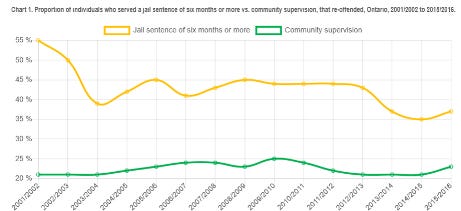
https://www.justice.gc.ca/eng/rp-pr/jr/jf-pf/2020/aug01.html (this graph is towards th bottom of the page.
The fairly obvious conclusion is that jailing people contributes substantially to recidivism.
This isn’t really all that surprising. Our jails are full of people who have been through the system many times and have time on their hands. When you introduce new offenders into this mix the long-haulers will subtly recruit them to the dark side. Jail for first time offender is the poorest option, but currently it is baked into the system.
The fundamental purpose of any justice system is to protect the majority of law-abiding citizens from a minority which would prey on them in one way or another. If the justice system is working properly then people should feel safe and well protected.
But people do not feel safe. In this regard, the conservatives have a point, but they blow it way out of proportion.
By its own admission, Canada’s penal system releases offenders into the community with the full knowledge and expectation that some of them will re-offend. (Reference to news articles of unreformed sex offenders being released.) Therefore, by definition, Canada’s penal system does not protect Canadians and, to that extent, is a failure.
Why do these people get released? Because they have served their ‘time’.- the period set down in law and/or imposed a judge.
Judges are not trained nor do they have the time to get inside an offender’s head and determine with any degree of certainty whether the person in front of them can be rehabilitated and how long it will take.
Our penal system offers all kinds of opportunities for rehabilitation – education to finish their high school, or learn a trade, or even take university courses. It offers treatment for addictions, mental disorders, anger management, etc. and statistics shows that it works. Research in the US shows that inmates who participate in correctional education programs have 43 percent lower odds of returning to prison than those who do not, and that every dollar spent on prison education saves four to five dollars on the costs of re-incarceration.
But a great many inmates forego these opportunities, partly from a lack of personal motivation and partly from peer pressure from other inmates. And, let’s face it – if you’re in for a specific time – your sentence – and you know that at the end you’re free, why bother. There’s no incentive other than your personal motivation.
And that’s the key. What does every prisoner want more than anything else – FREEDOM
We need to use FREEDOM as the incentive to rehabilitation – but that requires some lateral thing. Sentences would have to be made indeterminant – your sentence is complete only when you have demonstrated that you are rehabilitated and no longer a danger to society. And that would require that judges no longer do sentencing. That’s a paradigm shift from a practise that is centuries old.
Trials should be exclusively for the purpose of determining guilt or innocence and having reached a verdict the convict would pass into the hands of something akin to a parole board which would have the resources and time to evaluate the individual’s personality, motivations, education, family connections, addiction status, etc and determine the most appropriate course of rehabilitation and / or punishment. This process would be monitored and adjusted for each individual convict on a ongoing basis. All sentences would be indeterminate in length with release coming when the board has determined that the individual is ready for the world at large. The release could be gradual as it usually is now, but with an indefinite sentence the period of integration could be as long as necessary.
Rehabilitation and / or treatment would become the condition for release. This changes the dynamics and there would then be a real incentive to become rehabilitated. No longer will incarcerees who have refused treatment or training be released to prey again upon innocent people. Even repeat offenders currently in the system would be willing (sincere?) to rehabilitate in order to earn their release.
Regardless no system is perfect. Parole boards have frequently been fooled in spite of an extensive array of resources available. Re-offences will still occur under this system, but in reduced numbers. When a re-offender comes before the system again, the bar for his release will be that much higher. A second chance will be difficult to earn and subject to far more stringent scrutiny. A third chance? Maybe never.
With a prison population more inclined towards serious rehabilitation and knowing that release can come sooner rather than later, many of the current prison problems like boredom, drugs, and violence will be greatly reduced. And with the re-offenders locked up for longer and longer periods (preferably far away from those that want to go straight), there will be fewer bad eggs on the outside to lead newly released incarerees astray.
The result, fewer criminals on the street, an easier job for the police and a population that can feel more confident about their safety.
If the justice system gets back to its core functionality of protecting society and the penal system accepts a new mandate to rehabilitate without the constraints of specific sentences then Canada will be a safer country.
This should be something that both conservatives and progressives can agree on. Let me know what you think in the comments.
I have been looking into transferring my blog to Substack because it seems to give more opportunities to expand my reach.
However I wasn’t able to copy my email list across – I’m still trying, but in the meantime could you please click the button here
You will find a subscribe button there with a box for your email address (plus friends & contacts). While you’re there you can forward this article or previous ones to other people, and you can comment (Please do)
The election is only a couple of days away so I’m sure that will provide plenty of fodder for more articles in the near future
